Head injury: why does recovery vary?

Emergency numbers
United States: 911
United Kingdom: 999 or 112
European Union: 112
Elsewhere: your local emergency number
Short answer. Recovery after a traumatic brain injury can vary enormously because the nature and severity of injuries, previous health, associated symptoms, treatments, activity demands and environment differ between individuals. Two patients with the same initial severity label will not necessarily follow the same pathway. Progress may be uneven, and direct comparisons between people can obscure what is actually changing.
Important
Important. Neurological deterioration after a recent impact, difficulty waking the person, a seizure, new weakness, speech problems or increasing confusion requires emergency medical help: call emergency services immediately. Slow progress, fatigue or persistent dizziness needs appropriate medical advice, but must be distinguished from acute emergency signs. This article is not a tool for individual prognosis.
Why do two people with a similar injury progress at different rates?
The categories mild, moderate and severe describe aspects of the initial condition, such as consciousness, memory of the impact or observed injuries. They matter for care but do not capture the person’s entire future functioning.
Several factors play a part: the injuries themselves, associated problems such as neck pain, visual or vestibular difficulties and sleep problems, previous illnesses and everyday demands. Age, medication and access to care can also influence needs and available support. None of these factors alone can predict a recovery date.
Imagine two people who can both find their way to the supermarket again. One can shop alone at a quiet time; the other struggles more with the lights, noise and quick decisions. Their difficulty may not be apparent in a first conversation, but neither is it identical. Look at the actual activity, beyond the diagnostic label.
Why can progress be followed by a bad day?
A day in recovery is not an examination to pass or fail. After an injury, sleep, pain, fatigue, task intensity and distractions can make performance fluctuate. Someone may walk further on Monday, then cope less well with a meeting on Tuesday after a short night’s sleep. This does not automatically mean another injury has occurred.
However, expected fluctuations must be distinguished from concerning deterioration. Sudden neurological worsening after a recent injury must never automatically be attributed to fatigue. Outside an emergency, if someone has a sustained loss of an ability, symptoms increase markedly or their capabilities shrink over the weeks, reassessment can look for other causes.
When reviewing progress, asking whether everything has disappeared is sometimes less useful than asking whether the same activity requires fewer breaks than fifteen days ago. This should not become another performance demand: it simply helps make sometimes subtle progress more visible.
Why can returning home reveal new difficulties?
In hospital or a rehabilitation centre, many things are organised: schedules, meals, medicines, transport and appointments. Returning home hands the person many small but real decisions: remembering shopping, preparing a prescription, answering a message while watching food cook, or remembering a change of plan.
This different environment may make attention, planning or mental stamina problems more apparent when they were less challenged in a protected setting. It does not prove they have only just appeared; sometimes the demands have changed.
Those close to the person may interpret this gap as a lack of effort: if you could talk to the doctor, why can you not organise dinner? Yet sustaining a short conversation and coordinating several tasks do not use exactly the same resources. Describing the activities concerned helps resolve this misunderstanding without assuming a single cause.
How can you follow progress without turning everything into a dashboard?
A very simple notebook may help at a consultation. There is no need to record every sensation every minute; choose two or three activities that really matter to the person: reading a page, preparing a meal, walking to a familiar place or following a group discussion.
For each, occasionally note:
1. The situation: quiet or noisy surroundings, time of day and length of the activity.
2. Help needed: none, a reminder, assistance or an equipment adaptation.
3. The effect afterwards: moderate fatigue, a long break needed, symptoms unchanged or markedly increased.
4. Changes over time: what is becoming easier, remains difficult or is getting worse.
For example, three weeks ago you left the family meal after ten minutes; this week you can stay twenty minutes if you sit somewhere quieter. This is not a standardised measure or clinical score, but a useful, verifiable account of everyday life.
If tracking becomes anxiety-provoking or exhausting, simplify it or stop: the notebook should support the consultation, never run the person’s life.
What can be adapted at work, in education or within the family?
An adjustment aims to make an activity more accessible without assuming the person must remain at a reduced level indefinitely. Depending on the difficulties and with the relevant professionals, options may include shorter work periods, written instructions, a less stimulating environment, predictable breaks or a different division of tasks.
Those close to the person can also avoid two extremes: doing everything for them or expecting an immediate return to previous functioning. A more useful question is what they would like to do independently today and what help would actually be useful. Limits needed for safety can be discussed and reviewed with healthcare staff rather than presented as permanent.
Some jobs carry specific risks: driving, working at height, machinery or supervising others. Returning then needs an appropriate assessment, not just the observation that the person feels better.
Why can targeted care change everyday life?
Simply saying that the brain needs time is not enough when symptoms cause lasting disruption to life. The main difficulties may differ: headaches, dizziness, vision, sleep, pain, memory, irritability, anxiety or cognitive fatigue. The doctor can look for associated causes or complications and, when needed, refer for rehabilitation or an appropriate specialist.
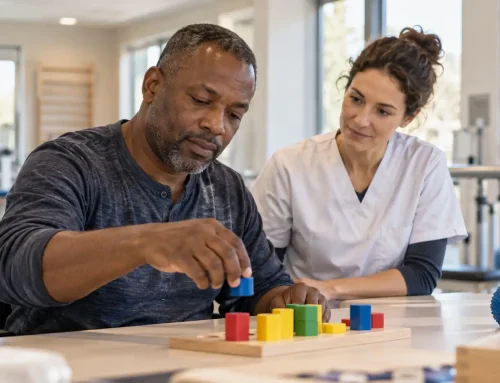
After a moderate or severe injury, rehabilitation pathways may involve several professions according to need: physiotherapy, occupational therapy, speech and language therapy, neuropsychology or social support. The aim is to help people use their abilities, regain important activities and manage persistent difficulties. The exact services and arrangements depend on the healthcare system and the team’s decisions.
Revisiting a goal may also help. Returning to a full day at the office may take several stages. Real progress is not limited to immediately returning to life as it was; it may also mean less help, less fatigue or more choices in everyday life.
When should you seek advice again if progress seems to have stalled?
Seek reassessment if symptoms are not improving as expected, worsen when you resume activities or persistently prevent important tasks. For mild concussion, the CDC specifically advises seeking advice when symptoms continue beyond two to three weeks; this guide cannot be applied unchanged to severe brain injury or every rehabilitation pathway.
Prepare an example of progress, an example of difficulty and a specific question for the consultation. For instance, you walk further but still cannot follow a meeting, and want to know whether attention and noise can be assessed. This supports targeted follow-up without promising a quick solution to every problem.
Frequently asked questions
Key takeaways
Recovery is not the same race for everyone. Differences in injuries, environment and activities explain some variation but do not provide an automatic prognosis. Observing a few important situations, adapting tasks and reassessing persistent difficulties is often more useful than comparing people or waiting for a theoretical recovery date.
Sources
MSKTC — TBI Recovery: The Recovery Process
MSKTC — Understanding Traumatic Brain Injury
MSKTC — TBI and Acute Inpatient Rehabilitation
Model Systems Knowledge Translation Center, « Understanding TBI: Part 1 — What happens to the brain during injury and the early stages of recovery ». — https://msktc.org/tbi/factsheets/understanding-tbi-part-1-what-happens-brain-during-injury-and-early-stages-recovery
Centers for Disease Control and Prevention, « Recovery from a Moderate or Severe TBI », 6 August 2025. — https://www.cdc.gov/traumatic-brain-injury/response/moderate-severe-tbi.html
Centers for Disease Control and Prevention, « What to Do After a Mild TBI or Concussion », 15 September 2025. — https://www.cdc.gov/traumatic-brain-injury/response/index.html
Centers for Disease Control and Prevention, « Managing Return to Activities », 28 July 2025. — https://www.cdc.gov/heads-up/hcp/clinical-guidance/
Centers for Disease Control and Prevention, « Symptoms of Mild TBI and Concussion », 15 September 2025. — https://www.cdc.gov/traumatic-brain-injury/signs-symptoms/index.html
National Institute for Health and Care Excellence, « Head injury: assessment and early management », NG232, 2023. — https://www.nice.org.uk/guidance/ng232/chapter/recommendations
Service-Public, « Quels sont les numéros en cas d’urgence ? », verified on 25 August 2026. — https://www.service-public.gouv.fr/particuliers/vosdroits/F33954
Last editorial review: October 2026
Partagez cet article, choisissez votre plateforme !
 Numa Costa
The pen name under which I write my articles and develop my editorial websites. Curious by nature, I enjoy understanding how things work, exploring everyday questions and making information easier to understand and use.
→ Learn more about the author