Immediate memory and long-term memory

Important: the terms used here explain concepts; they are not diagnoses. After a recent head injury, increasing disorientation, difficulty waking someone, a seizure or a new neurological sign requires urgent assessment: call emergency services immediately.
Emergency numbers
United States: 911
United Kingdom: 999 or 112
European Union: 112
Elsewhere: your local emergency number
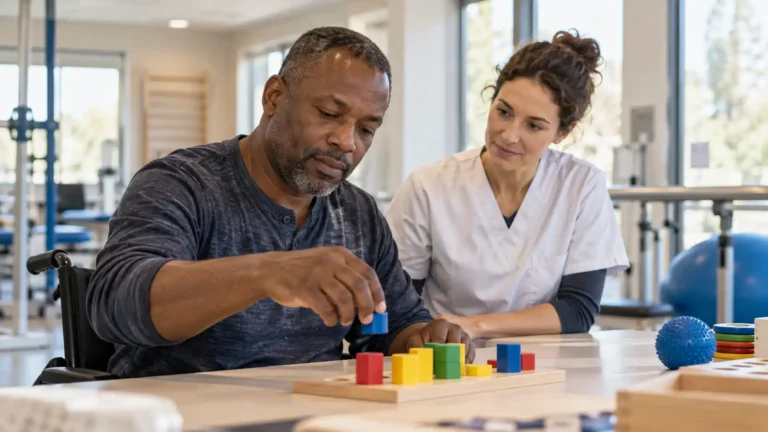
Immediate memory holds information very briefly; long-term memory stores knowledge or events well beyond the present moment. Between the two, you must pay attention, record and stabilise new information. After a traumatic brain injury, someone may describe a childhood memory precisely but forget what has just been explained. This is not contradictory: established memories and learning new information do not rely on exactly the same processes.
Important
This article provides general information. It cannot diagnose a brain injury or assess the seriousness of an individual situation remotely, and it does not replace an examination or advice from a qualified healthcare professional.
Three different stages in an everyday situation
You meet a new neighbour. First you hear their name and keep it in mind for a few seconds while replying. Then you associate it with a face or context, which may help you learn it. Two days later, you try to recall the name when you meet again.
Each stage raises a different question: was the information available initially? Was it sufficiently learned? Has it become difficult to retrieve despite being learned properly? These are commonly grouped as memory problems, although different aids may help.
Working memory, adds another process: using information during a task. It is not simply keeping it for longer. Holding a code for a few seconds while opening a form calls on this ability as well as immediate retention.
Why might older memories be better preserved?
An older event may already have been repeated, retold or associated with many cues. New information must be learned under the conditions of the moment. After some injuries, particularly moderate to severe ones, this new learning may be harder even when many earlier memories remain accessible. This does not mean all older memories are spared.
For example, someone readily describes a holiday from ten years ago. That same day, they repeatedly ask the appointment time. The first observation does not prove normal memory function; the second does not mean they do not understand the appointment. They may struggle to retain or retrieve new information.
Conversely, recognising a face without recalling a name does not necessarily indicate poor learning: retrieval cues may be insufficient at that moment. Context, such as remembering that you met at the swimming pool, can sometimes help recall.
How can you tell whether the problem occurs during encoding or retrieval?
Only appropriate assessment can explore these mechanisms in detail, but simple observations help describe what happens:
• Before: was there noise, pain, significant fatigue or several simultaneous instructions? Was the information actually understood?
• During: can the person restate the information in their own words a few seconds later? Does a note or visual aid make a difference?
• Afterwards: what remains the next day? Is a cue enough to retrieve it, or does everything need explaining again?
This brief record cannot establish a precise neurological cause. It mainly avoids treating all forgetting as equivalent and supports discussion with a doctor or neuropsychologist.
Fatigue and attention problems may limit initial recording. Sleep, medication and emotional symptoms also deserve consideration without automatically attributing difficulties to any one of them.
Supporting learning: an example rather than a magic formula
Suppose someone needs to learn the route to a new appointment venue. Start by showing the route on a map, identifying two stable landmarks, providing an accessible note and repeating the journey with support if conditions allow. The aim is not immediate memorisation of every street, but building a usable routine with cues available at the right moment.
For a new work procedure, a short list with screenshots may be more valuable than a long spoken explanation. Repeating a name in context is sometimes more useful than forcing meaningless recitation. These strategies rely on organisation, repetition and reducing distractions; they do not guarantee recovery.
Take care with safety-sensitive activities: forgetting involving medication, cooking, driving or a financial transaction should not be compensated for with an improvised trick. Make the activity safe with professional advice and, where needed, support from those close to the person.
Procedural memory: why do some actions remain easy?
Some automatic skills, such as carrying out a familiar routine, may be relatively better preserved than learning new information. MSKTC distinguishes this procedural memory from memory for events and appointments. However, it is not invulnerable and varies with the injury.
For example, someone may prepare a familiar dish through a series of known actions but need a written recipe for a new dish. This observation should not become a judgement that being able to do one thing means they must be able to remember another. The tasks call on different types of memory.
When does assessment change decisions?
If forgetting compromises independence, education, work or relationships, consultation helps define what needs further exploration. The doctor may refer for neuropsychological assessment and, according to need, rehabilitation or environmental adaptations. The aim is to distinguish preserved strengths, observable difficulties and safety requirements.
Ask not only how many words are recalled in a test, but how the person packs a bag, learns a new route or follows a conversation. Everyday experience complements measurements made during consultations.
Frequently asked questions
Key takeaways
Briefly holding information, learning it and retrieving it later are different processes. Preserved older memories do not rule out difficulty remembering new events. Observations of when forgetting occurs and which aids work can prepare for a relevant assessment without self-diagnosis.
Sources
MSKTC — Memory Problems After Traumatic Brain Injury
MSKTC — Cognitive Problems after Traumatic Brain Injury
Model Systems Knowledge Translation Center, Bell (2024), « Fatigue and Traumatic Brain Injury ». — https://msktc.org/tbi/factsheets/Fatigue-And-Traumatic-Brain-Injury
Centers for Disease Control and Prevention (15 September 2025), « Symptoms of Mild TBI and Concussion ». — https://www.cdc.gov/traumatic-brain-injury/signs-symptoms/index.html
Service-Public (25 August 2026), « Quels sont les numéros en cas d'urgence ? ». — https://www.service-public.gouv.fr/particuliers/vosdroits/F33954
Last editorial review: October 2026
Partagez cet article, choisissez votre plateforme !
 Numa Costa
The pen name under which I write my articles and develop my editorial websites. Curious by nature, I enjoy understanding how things work, exploring everyday questions and making information easier to understand and use.
→ Learn more about the author