
Head injury: understanding what happens after an impact
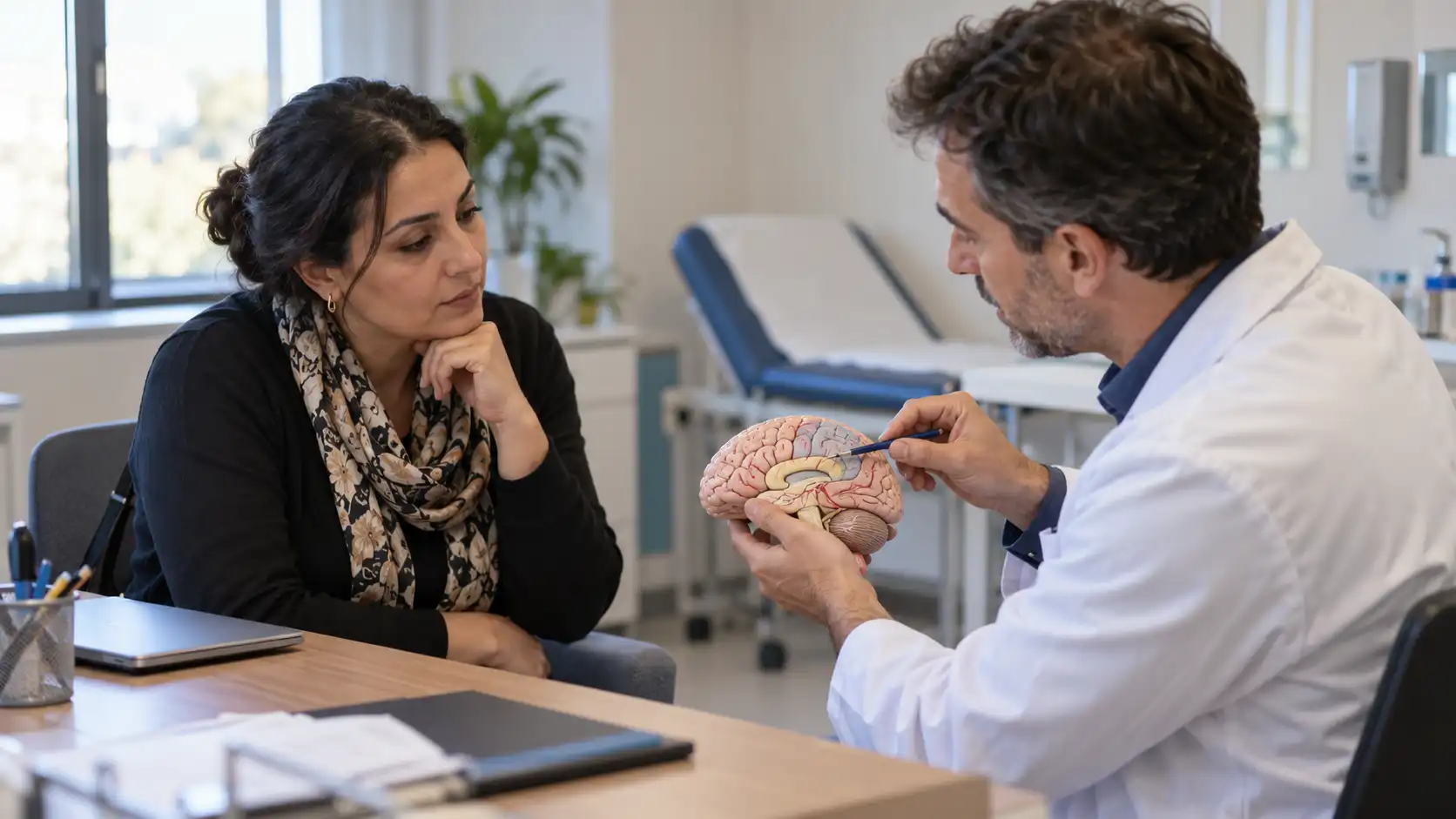
Short answer. A blow to the head can cause a concussion, which disrupts brain function, or injuries such as bruising of brain tissue or bleeding. These are not equivalent situations. Symptoms, medical examination and the circumstances of the accident help determine the risks and care required. A normal CT scan does not rule out concussion.
Emergency numbers
United States: 911
United Kingdom: 999 or 112
European Union: 112
Elsewhere: your local emergency number
Important
Important. This article explains the mechanisms in general terms. It cannot determine the nature or severity of an injury remotely. Impaired consciousness, a seizure, a neurological deficit or deterioration after the accident requires emergency help: call emergency services immediately.
What happens to the brain at the moment of impact?
The brain is protected by the skull and surrounded by fluid. Yet when the head accelerates, slows abruptly or rotates, forces are not distributed evenly. Tissues, small blood vessels and nerve cell extensions may be affected differently depending on the movement and its intensity.
This explains why two people in apparently similar accidents may have different symptoms. The visible force of the impact alone cannot establish its consequences.
An important distinction is between:
• Functional disruption, as in some concussions, where communication between nerve cells is temporarily affected without necessarily producing an injury visible on standard imaging.
• Structural injuries, such as a brain contusion or bleeding, some of which can be detected on imaging. They require assessment and sometimes emergency treatment.
These categories simplify the reality: several mechanisms may coexist, and only medical assessment can distinguish them in an individual person.
Why can a CT scan be normal when symptoms are very real?
In the acute setting, a brain CT scan mainly looks for certain significant injuries, particularly bleeding. It is not designed to measure every disruption of brain function directly. Someone may therefore have headaches, feel slowed down, struggle with attention or feel dizzy despite a CT scan showing no detectable abnormality.
This does not mean the symptoms are imaginary. It also does not necessarily mean that a serious abnormality has been missed. The result needs to be interpreted alongside the clinical examination, changes in symptoms and follow-up instructions.
Doctors do not automatically order a CT scan after every head injury. Their decision takes account of neurological signs, age, certain medicines, loss of consciousness, vomiting and the mechanism of the accident. Do not try to apply an imaging rule found online yourself.
Why can a conversation or an ordinary day become tiring?
Following a conversation in a noisy place requires listening, filtering surrounding sounds, remembering what has just been said and preparing a response. Reading on a screen also requires sustained attention and processing several pieces of information.
After concussion, some people describe feeling slowed down, sensitivity to noise, unusual fatigue, concentration difficulties or sleep problems. These symptoms are documented, but their presence alone does not identify their exact cause: neck pain, visual problems or other factors may also contribute.
The purpose of this example is to connect a general complaint, such as getting tired quickly, with observable situations. It should not be used to devise an exercise programme or a recovery timeline for everyone.
How do professionals assess the situation?
Assessment begins with the circumstances of the accident and the signs that have appeared since. It may include examining alertness, movement, balance, memory or other neurological functions. The practitioner first looks for complications requiring a rapid response, then decides whether monitoring, imaging or follow-up is needed.
The word mild in mild traumatic brain injury describes an initial clinical classification. It does not guarantee insignificant symptoms or immediate recovery. If difficulties persist or interfere with activities, reassessment is useful.
People close to the injured person can contribute by describing what they saw at the time of the impact: confusion, loss of consciousness, repeated questions or changes in behaviour. Their account complements, without replacing, that of the person concerned.
Three useful questions to ask after a head injury
Which signs mean I should contact the emergency department again? Ask about warning signs relevant to your situation, particularly if symptoms change.
Which activities can I resume, and at what pace? Returning to work, education, sport or driving needs to reflect the assessment and instructions received, rather than a single timetable.
Whom should I contact if fatigue, dizziness or concentration difficulties persist? Note the professional responsible for your care and the planned follow-up arrangements.
Does a head injury always cause loss of consciousness?
No. A concussion or another brain injury can occur without loss of consciousness. Its absence is therefore not enough to rule out an injury.
Frequently asked questions
Key takeaways
The impact, visible injuries and symptoms are three different things. Their relationship is not always immediately apparent. Medical assessment identifies emergencies, interprets symptoms and clarifies follow-up; a CT scan is only one possible part of that assessment.
Sources
MSKTC — Understanding TBI: Part 1 – What Happens to the Brain During Injury and Early Recovery
CDC — Traumatic Brain Injury & Concussion
CDC — About Mild TBI and Concussion. — https://www.cdc.gov/traumatic-brain-injury/about/index.html
NICE — Head injury: assessment and early management (NG232), recommendations. — https://www.nice.org.uk/guidance/ng232/chapter/recommendations
CDC — Symptoms of Mild TBI and Concussion. — https://www.cdc.gov/traumatic-brain-injury/signs-symptoms/index.html
Last editorial review: October 2026
Partagez cet article, choisissez votre plateforme !
 Numa Costa
The pen name under which I write my articles and develop my editorial websites. Curious by nature, I enjoy understanding how things work, exploring everyday questions and making information easier to understand and use.
→ Learn more about the author