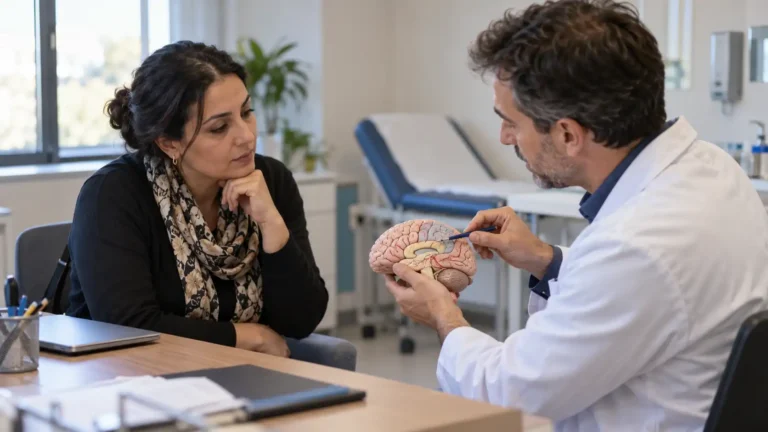
Balance problems after a head injury: when should you seek medical advice?

New difficulty standing, walking straight or coordinating movements after a head injury requires emergency medical help. Call emergency services immediately, particularly with confusion, weakness, double vision or vomiting. Less dramatic dizziness also deserves appropriate assessment after injury; self-testing cannot establish its cause.
Emergency numbers
United States: 911
United Kingdom: 999 or 112
European Union: 112
Elsewhere: your local emergency number
Balance involves several mechanisms. Someone may have strong legs yet veer while walking; another feels spinning on turning their head or loses bearings in darkness. Descriptions guide professionals but never replace checking serious warning signs.
Important
This article provides general information. It cannot diagnose a brain injury or assess the seriousness of an individual situation remotely, and it does not replace an examination or advice from a qualified healthcare professional.
First distinguish an emergency from persistent difficulty
After recent injury, new inability to walk normally, lost coordination, one-sided weakness, speech problems, unconsciousness or reduced alertness, seizures, worsening headache, vomiting after injury or double vision justifies an immediate emergency call. One important abnormality is enough; waiting for several wastes time.
Even after examination, do not automatically attribute a new problem or sudden worsening to the original concussion. Tell the call handler what changed and when. Do not let an unsteady person drive; limit fall-risk movement pending instructions.
For example, someone initially walks normally after falling, then veers strongly right and needs walls for support. This cannot wait until tomorrow: call emergency services and describe progression. Conversely, persistent swaying weeks after initial assessment warrants follow-up, but its cause and possible rehabilitation need separate assessment.
Vertigo, light-headedness and imbalance are different experiences
Vertigo may feel as though the room spins or a stationary body moves. Light-headedness may occur particularly on standing. Imbalance is more apparent walking, turning or crossing uneven surfaces. Sensations may overlap.
Describe what you felt, what you were doing and how long it lasted. A few seconds of movement sensation when turning the head while rising is more informative than general dizziness. Avoid deliberately reproducing symptoms if falling is possible.
Our article on dizziness specifically explores dizziness, descriptions and useful assessment questions. This article concerns safe walking and appropriate professional referral.
Why several systems may be involved
The brain organises visual, inner-ear vestibular and muscle/joint position information together to adjust posture. After injury, mismatch may cause difficulty on stairs, while turning the head or within moving crowds.
Other factors include blood-pressure drops on standing, neck pain, medication effects, fatigue or visual difficulties. These are possibilities, not self-diagnoses. One sensation may have several causes. Instability with eyes open in a shopping centre and loss of balance only on rising from bed may require different examinations.
Assessment may examine walking, eye movements, vestibular function, blood pressure and medication. Some need vestibular care; others visual, neurological or movement assessment. Balance rehabilitation is not one exercise for everyone.
Making everyday actions safer without unnecessary inactivity
After medical advice on permitted movement, temporary home simplification may help: clear corridors, remove slippery rugs, light night-time routes and keep a phone and essentials nearby. Ask whether showering, stairs or outings need equipment or assistance.
Avoid courage tests such as standing on one leg with eyes closed, climbing chairs or walking alone in darkness. These have no diagnostic value and risk another fall. Conversely, weeks of complete inactivity without medical indication may hinder return. Ask which movements can safely resume and how to progress them.
A prescribed or recommended walking aid is not necessarily permanent. Independence can develop step by step according to observed abilities and risks without forcing too rapid a return.
Measuring improvement in real situations
Feeling better or having a bad day is often too vague for follow-up. Choose two or three observable situations: bedroom to kitchen, a corridor turn or five minutes walking with support. Record assistance, breaks, near-falls and aggravating conditions. The aim is identifying needs rather than a perfect score.
Bring observations and report falls even without injury. Sudden symptom changes or new neurological signs are not ordinary follow-up matters: seek emergency help.
A common question: can balance be lost without spinning?
Yes. Walking, visual, body-position perception and coordination problems can cause unsteadiness without rotational vertigo. Assessment depends on circumstances, not vocabulary alone.
Frequently asked questions
Key takeaways
New walking difficulty after traumatic brain injury is a warning sign, not a home balance exercise. Once emergency causes are excluded, precise descriptions help investigate systems involved and adapt movement and rehabilitation.
Sources
CDC — Symptoms of Mild TBI and Concussion — 2025
NHS — Head injury and concussion — 2025
MSKTC — Balance Problems after Traumatic Brain Injury
National Institute for Health and Care Excellence, « Head injury: assessment and early management », NG232, 2023, — https://www.nice.org.uk/guidance/ng232/chapter/recommendations
Assurance Maladie, « Que faire en cas de vertiges ? », 29 September 2025, — https://www.ameli.fr/assure/sante/themes/vertiges/bons-reflexes-que-faire
Assurance Maladie, Nausées et vomissements : que faire et quand consulter ?, 31 July 2024. — https://www.ameli.fr/assure/sante/themes/nausee-vomissement/que-faire-cas-faut-consulter
Last editorial review: October 2026
Partagez cet article, choisissez votre plateforme !
 Numa Costa
The pen name under which I write my articles and develop my editorial websites. Curious by nature, I enjoy understanding how things work, exploring everyday questions and making information easier to understand and use.
→ Learn more about the author