Rehabilitation after a traumatic brain injury: how does it work?
Important: this article presents rehabilitation after the initial medical phase. Sudden neurological deterioration, a seizure or difficulty waking someone after a recent head injury requires urgent assessment: call emergency services immediately. A rehabilitation programme never addresses an acute emergency.
Emergency numbers
United States: 911
United Kingdom: 999 or 112
European Union: 112
Elsewhere: your local emergency number
Rehabilitation after traumatic brain injury identifies what actually hinders a person, then works towards suitable goals with the relevant professionals. It may address walking, communication, memory, fatigue, emotions or everyday tasks. Exercises are not an end in themselves: the aim is to regain ways to act and participate in life, using compensatory strategies where necessary.
Important
This article provides general information. It cannot diagnose a brain injury or assess the seriousness of an individual situation remotely, and it does not replace an examination or advice from a qualified healthcare professional.
What does a rehabilitation pathway look like?
No standard pathway fits every injury. Someone with concussion may need targeted follow-up for persistent symptoms; another person after longer hospitalisation may need several coordinated therapies. Professionals assess physical, cognitive and sensory abilities and the activities the person wants to resume. Initial injury severity cannot sum up needs weeks or months later.
Some rehabilitation takes place in a facility; other care continues in consultations, at home or with health and social support services. Assessment, surroundings and actual follow-up options guide the choice. US descriptions of intensive rehabilitation units do not prescribe duration or frequency for a patient in France, the setting addressed by the original article.
Programmes may change: a hospital priority, such as transferring from bed to chair, may no longer be the main problem at home, where arranging appointments or crossing a noisy neighbourhood can become harder.
Who does what in the team?
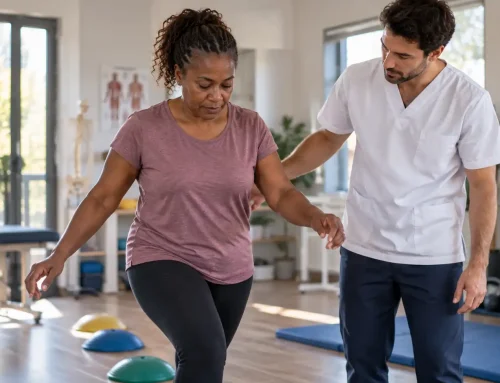
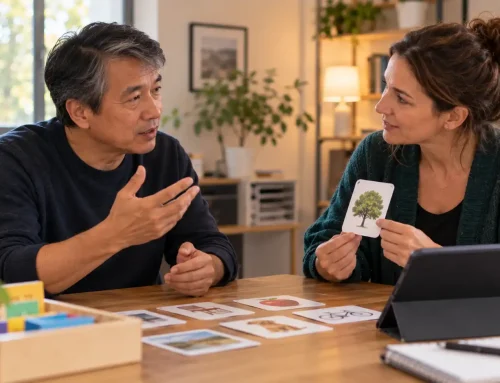
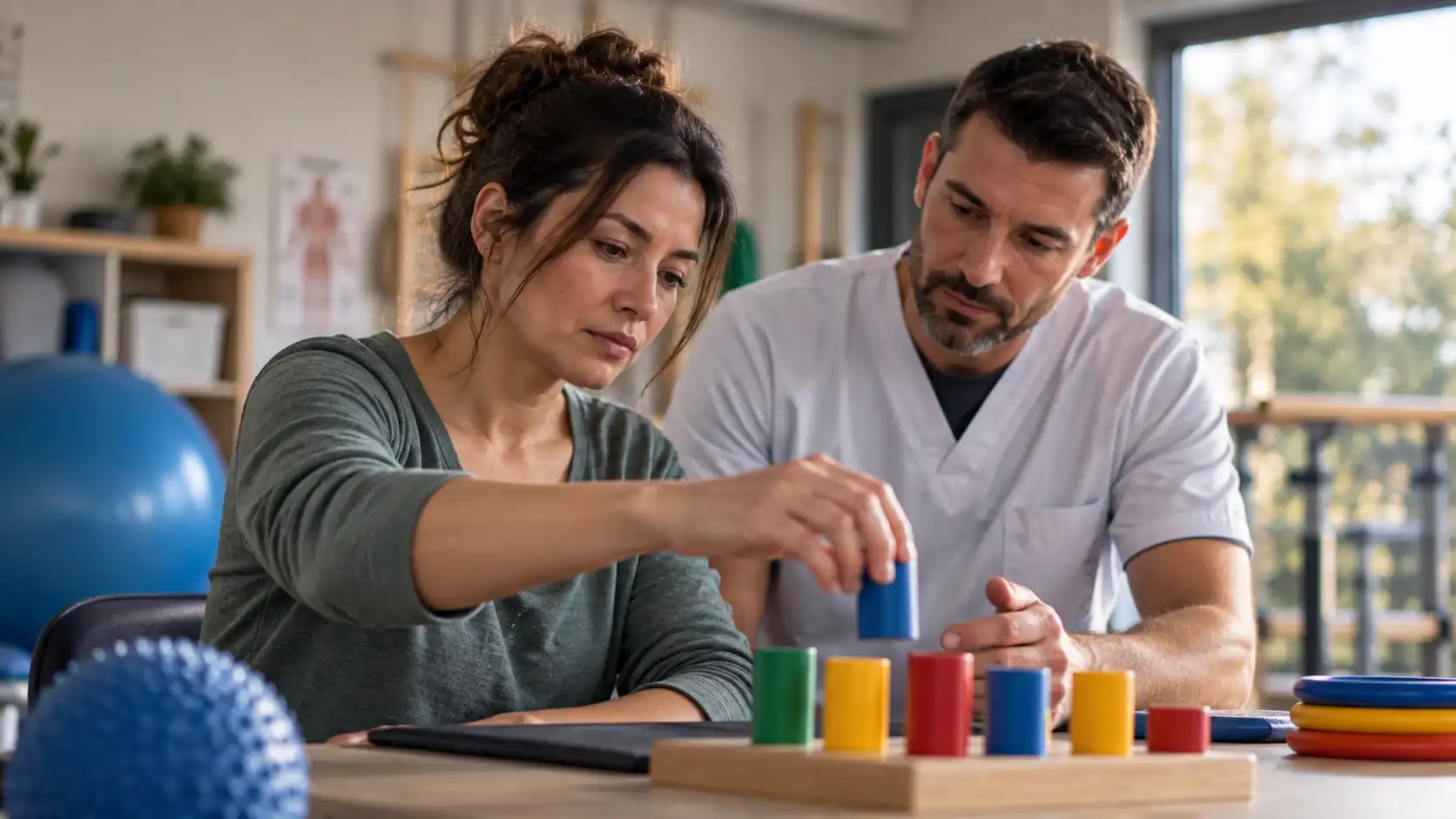
The doctor overseeing care, sometimes a specialist in physical and rehabilitation medicine, helps assess needs, risks and the pathway’s coherence. Physiotherapists address mobility, transfers, balance or walking. Occupational therapists examine how to carry out activities and adapt surroundings. Speech and language therapists may address language, cognitive communication and, according to need, swallowing. Neuropsychologists help analyse attention, memory and executive functions. Psychology professionals, nursing teams, social workers and others may also contribute.
This is neither a collective prescription nor a mandatory team: each professional intervenes for an assessed need. Coordination matters more than accumulating sessions. If two professionals recommend incompatible changes or the week becomes exhausting, the programme should be open to discussion and reorganisation.
How can you define a genuinely useful goal?
Improving independence is an intention, not yet a working goal. Ask which specific activity presents an obstacle.
Consider someone wanting to prepare lunch without a relative checking every step. The team may explore standing, finding utensils, following a recipe, managing two pans, recognising burn risk or tolerating noise. Interventions differ with the main obstacle. The goal might be making a simple meal using a list, then checking the strategy actually works at home.
Goals must be reviewable with the person. They can be ambitious without denying limitations and modest without infantilising. Managing with an assistive device is functional progress; it is not necessarily failure because an action no longer looks exactly as before.
Why does success in a session not guarantee success outside?
A quiet room and an exercise presented step by step greatly simplify a task. A station or workplace also demands coping with conversations, movement, unexpected events and fatigue. A strategy working for twenty minutes in a clinic may be difficult late in the day.
For example, someone manages three written instructions perfectly with a therapist. At the supermarket, they forget the second when an announcement sounds. The solution is not necessarily longer practice of the same exercise. Try a divided list, fewer purchases, a quiet time or gradually supported, more complex outings. Success is then measured by transfer to the real situation, not an exercise score alone.
Rehabilitation may combine learning abilities, compensatory tools and environmental adjustments. These approaches are compatible. Someone can keep working on attention while using reminders today to avoid missing appointments.
How can you monitor progress without discouragement?
Recovery is not always linear. Sleep, pain, emotions, medication and demands can change performance between days. Recording only a good or bad day helps little when deciding what to change.
A more useful observation has four elements: activity attempted, context, aid used and consequence. For example: twenty minutes shopping, quiet shop, phone list, substantial fatigue afterwards. Comparable observations may show whether activity becomes more accessible, help remains necessary or fatigue costs too much.
Report new changes, falls, swallowing difficulties, marked psychological problems or fatigue preventing any participation. Healthcare staff can distinguish the need for session adjustments, further assessment or attention to another medical problem.
Three questions for the rehabilitation team
• Which concrete outcome are we working towards now? Ask how it will be observed outside sessions.
• Which strategies can I use today? A useful aid need not wait until rehabilitation ends.
• When and with whom will the goal be reviewed? Needs change with returning home, to education or employment.
These questions support shared decisions. They do not require family and friends to become therapists; their role may simply be supporting an understood, accepted strategy without replacing every initiative.
Frequently asked questions
Key takeaways
The best rehabilitation is not necessarily the one with most sessions. Its goals matter to the person, professionals coordinate their actions and results can be verified in real life.
Sources
MSKTC — Acute Inpatient Rehabilitation for TBI
MSKTC — How a Traumatic Brain Injury Impacts Daily Life
Model Systems Knowledge Translation Center, « Cognitive Problems After Traumatic Brain Injury ». — https://msktc.org/tbi/factsheets/cognitive-problems-after-traumatic-brain-injury
American Speech-Language-Hearing Association, « Traumatic Brain Injury in Adults ». — https://www.asha.org/practice-portal/clinical-topics/traumatic-brain-injury-in-adults/
Centers for Disease Control and Prevention, « Symptoms of Mild TBI and Concussion ». — https://www.cdc.gov/traumatic-brain-injury/signs-symptoms/index.html
Last editorial review: October 2026
Partagez cet article, choisissez votre plateforme !
 Numa Costa
The pen name under which I write my articles and develop my editorial websites. Curious by nature, I enjoy understanding how things work, exploring everyday questions and making information easier to understand and use.
→ Learn more about the author