Moderate traumatic brain injury: effects and care
Emergency numbers
United States: 911
United Kingdom: 999 or 112
European Union: 112
Elsewhere: your local emergency number
Short answer. A moderate traumatic brain injury describes a more significant initial injury than a mild one, without necessarily representing the most severe presentation. The person may need hospital monitoring and, depending on their progress, physical, cognitive or social rehabilitation. The initial category alone cannot predict their future independence.
Important
Important. A moderate traumatic brain injury requires hospital assessment and monitoring. After a recent impact, if someone becomes difficult to wake, has a seizure, weakness in a limb, significant confusion or breathing problems, call emergency services immediately. Do not try to classify the injury yourself from its outward appearance.
What exactly does moderate mean?
Healthcare staff consider the circumstances of the accident, neurological examination, memory of events and, when indicated, imaging together. The Glasgow Coma Scale measures certain responses at a given moment: eye opening, verbal response and motor response. In the classification presented by NICE, a score of 9 to 12 corresponds to moderate traumatic brain injury; 13 to 15 indicates the mild category and 8 or less the severe category.
This number must not be interpreted in isolation. Sedative medication, intubation, associated injuries or changes in the first few hours can complicate assessment. Two people given the same initial classification will not necessarily have the same symptoms or care pathway.
Moderate is therefore neither a verdict on the future nor an indication that care can wait. It is a clinical guide for the team’s decisions.
What do doctors look for during hospital care?
In the period following the impact, priorities are to assess neurological status, identify any intracranial injury and detect deterioration. Depending on the case, the team checks level of consciousness, pupils, limb strength and sensation, and vital signs. The indication for CT scanning and monitoring arrangements depend on the full clinical picture, not just pain intensity.
Healthcare staff also explain whether monitoring needs to continue, which findings warrant another examination and what determines discharge or transfer. Moving to another department does not necessarily mean everything is over: it may mark another stage in the care pathway.
For those close to the person, asking what the team is observing today and which changes would alter the plan is often more useful than seeking a precise recovery deadline.
Which difficulties may appear after consciousness returns?
Some limitations are visible: weakness in a limb, difficulty walking, balance or speech problems. Others are harder to recognise during a hospital visit: slower information processing, cognitive fatigue, problems with recent memory or difficulty organising several steps. Mood and emotional responses may also change.
For example, someone may dress independently and converse normally for a few minutes, yet need help managing a prescription, planning a journey and adapting to an unexpected event. Independence in one simple task does not guarantee independence throughout an entire day.
Do not automatically attribute every difficulty to the brain injury. Pain, poor sleep, medication and other complications may also contribute. Medical and rehabilitation assessments help distinguish these contributions.
What is rehabilitation for after a moderate injury?
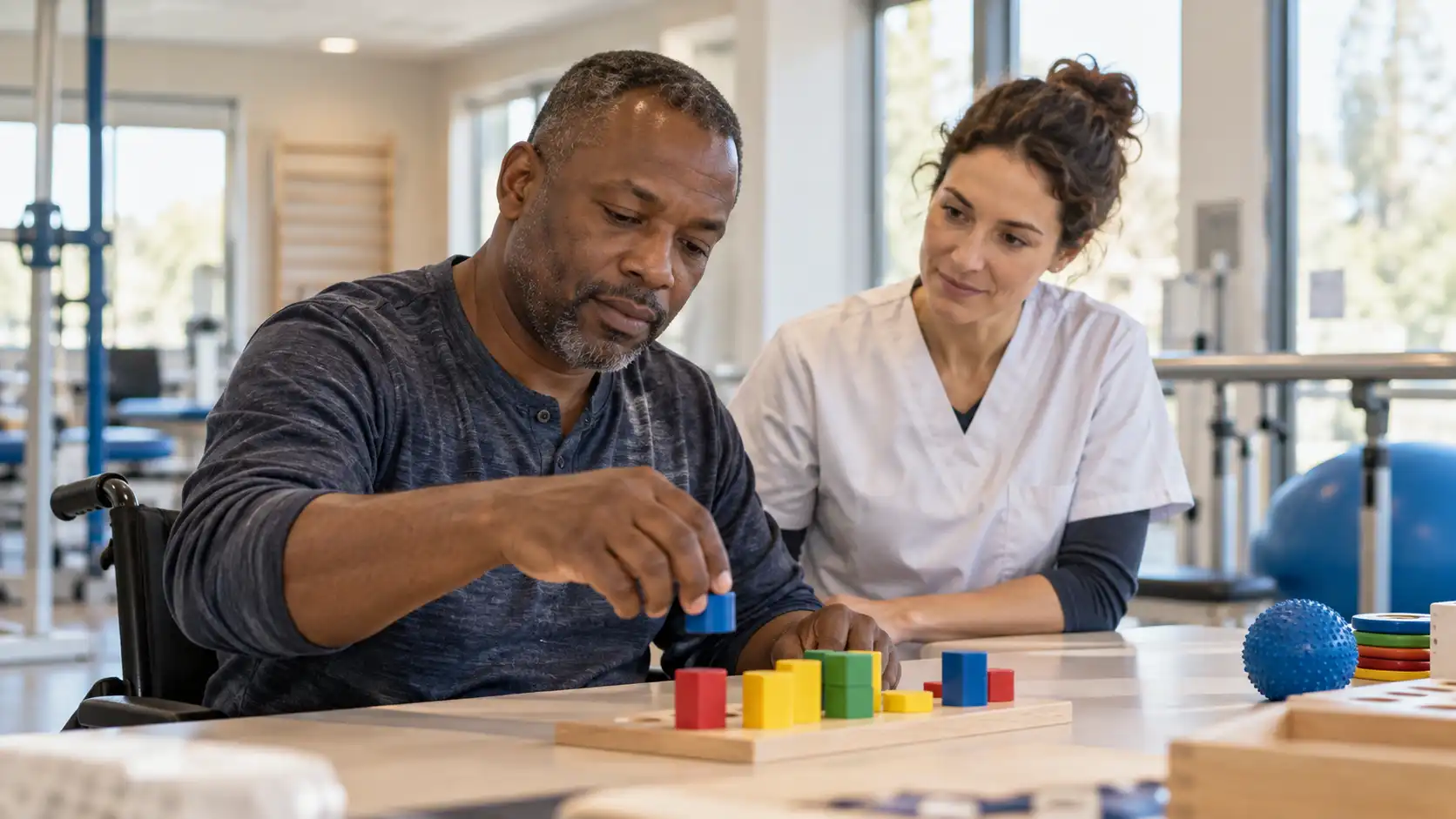
Rehabilitation is not limited to learning to walk again. Depending on assessed needs, care may involve physical and rehabilitation medicine, physiotherapy, occupational therapy, speech and language therapy, neuropsychology and social support. Goals vary: regaining useful movements, communicating more easily, managing fatigue, resuming activities or making discharge home safe.
An occupational therapist may, for example, analyse what makes preparing a meal or a journey difficult and then suggest adaptations. A speech and language therapist may address communication or swallowing difficulties depending on the assessment. These interventions are neither automatic nor identical for everyone.
Returning to work or education sometimes becomes a practical issue later than expected. A gradual return and adjustments can be discussed with the relevant professionals, particularly when attention, stamina or safety is affected.
How can you prepare for returning home without facing difficulties alone?
Hospital discharge often requires distinguishing what the person wants to do, what they can do in a quiet setting and what they can do safely and repeatedly at home. These do not always match at first.
Before discharge, useful questions for the team include:
1. Which activities are safe now, and which require help or supervision?
2. Which professionals will provide follow-up, and how do we arrange appointments?
3. Which changes in behaviour, alertness or symptoms mean we should contact a medical service again?
4. Which adaptations, assistive devices or social support arrangements need to be organised?
In the French setting addressed by the original article, the answers must fit the French system rather than automatically adopting US insurance procedures or services described in some international information sheets. Readers elsewhere likewise need arrangements appropriate to their own healthcare system.
Can recovery be predicted from the initial category?
No. Prognosis depends on many factors: injuries, complications, age, previous health, care and observed progress. Improvement may be noticeable early on and then slow down; functional gains sometimes remain possible later. It would be misleading to set a uniform recovery period or turn a group statistic into an individual promise.
Useful follow-up asks not only whether a score has improved, but also what matters in everyday life: having a conversation, planning an outing, resuming a valued activity, managing appointments or participating in a decision.
Frequently asked questions
Key takeaways
Moderate traumatic brain injury is a medical classification of the initial phase. Care combines assessment, monitoring and detection of complications, followed by rehabilitation and support when needed. Needs can differ greatly between individuals; they should be reassessed as the situation develops rather than inferred from one number.
Sources
MSKTC — Understanding Traumatic Brain Injury
MSKTC — TBI and Acute Inpatient Rehabilitation
MSKTC — TBI Recovery: The Recovery Process
National Institute for Health and Care Excellence, « Head injury: assessment and early management », NG232, 2023. — https://www.nice.org.uk/guidance/ng232/chapter/recommendations
Centers for Disease Control and Prevention, « Recovery from a Moderate or Severe TBI », 6 August 2025. — https://www.cdc.gov/traumatic-brain-injury/response/moderate-severe-tbi.html
Model Systems Knowledge Translation Center, « Understanding TBI: Part 1 — What Happens to the Brain During Injury and Early Recovery ». — https://msktc.org/tbi/factsheets/understanding-tbi-part-1-what-happens-brain-during-injury-and-early-stages-recovery
Last editorial review: October 2026
Partagez cet article, choisissez votre plateforme !
 Numa Costa
The pen name under which I write my articles and develop my editorial websites. Curious by nature, I enjoy understanding how things work, exploring everyday questions and making information easier to understand and use.
→ Learn more about the author