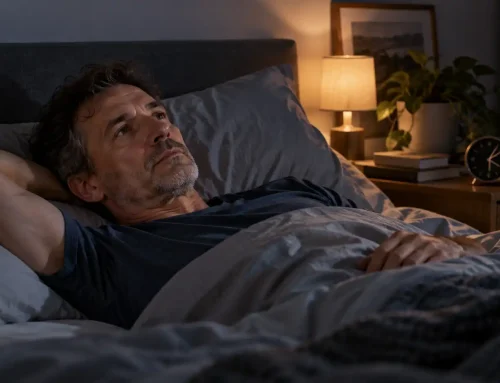
Excessive sleepiness after a traumatic brain injury

Important: someone who becomes difficult to wake, loses consciousness, develops increasing confusion or other concerning neurological signs after a recent head injury needs emergency help: call emergency services immediately. This article distinguishes that emergency from sleepiness persisting in daily life after the initial phase.
Emergency numbers
United States: 911
United Kingdom: 999 or 112
European Union: 112
Elsewhere: your local emergency number
Excessive sleepiness is a tendency to fall asleep when you want to remain awake. After a traumatic brain injury, it may occur on a bus, in front of a screen or during conversation. It differs from fatigue: you can lack energy without wanting to sleep, or fall asleep despite apparently sufficient rest. Repeated involuntary sleep episodes warrant medical assessment.
Important
This article provides general information. It cannot diagnose a brain injury or assess the seriousness of an individual situation remotely, and it does not replace an examination or advice from a qualified healthcare professional.
How can you recognise sleepiness rather than fatigue?
Someone who is fatigued often describes disproportionate effort: stopping while reading or no longer being able to concentrate. Someone who is sleepy struggles to keep their eyes open, may miss part of a film or unintentionally fall asleep in a meeting. Both experiences can coexist but raise different medical questions.
Context is useful: does sleepiness occur only in quiet surroundings, or even during an activity normally requiring attention? Do you have to fight dozing off? Do those close to you notice sleep at unusual times? The doctor considers frequency, circumstances and consequences.
Do not equate needing a lot of sleep with being constantly sleepy. Some sleep long hours without satisfactory recovery; others have short nights because they wake frequently. The experience alone cannot identify the cause.
Why can this happen after a brain injury?
Sleep and wakefulness depend on complex networks and signals. Injury may change how these mechanisms function. Pain, reduced activity, emotional difficulties or medication affecting alertness may also accompany it. These factors are not mutually exclusive: several reasons for sleepiness may coexist.
Assessment must also consider causes not directly arising from the injury: sleep debt, sleep apnoea, sedative medication or another sleep disorder. For example, someone sleeping eight hours but snoring with observed breathing pauses should not automatically attribute sleepiness to the injury. A partner’s observations can be valuable.
Nor can nap duration alone establish a diagnosis. Medical terms such as hypersomnia or narcolepsy describe conditions needing specialist assessment, not labels to choose online yourself.
The priority question: where does sleepiness become dangerous?
Sleepiness at the wheel or while operating a machine is more than inconvenient: it can cause an accident. If you fall asleep involuntarily, do not drive or use dangerous equipment until the situation has been assessed and made safe. Do not rely on an open window, a stimulating drink or willpower to guarantee alertness. France’s Assurance Maladie highlights the road, work and household risks of daytime sleepiness.
Dangers may also be less obvious: caring alone for a young child when you suddenly fall asleep, cooking with hobs on or bathing while fighting sleep. Relevant activities depend on the actual situation. Discussing this openly does not mean giving up independence; it means organising temporary safety measures to review with the professional overseeing recovery.
Neurological emergencies after a recent head injury are a different situation. If someone becomes unusually difficult to wake, vomits after the injury, develops new weakness, a seizure or increasing confusion, contact emergency services immediately. The vomiting alert retains the French public guidance cited here. Do not assume this is their usual sleepiness.
Four genuinely useful details for the consultation
Rather than simply saying you sleep all the time, prepare observations. First, say when episodes began and whether onset was sudden or gradual. Second, describe a specific situation, such as falling asleep almost daily on the train after ten minutes. Third, note usual sleep times, waking and naps. Fourth, bring a medication list, including occasional medicines.
If someone close has noticed snoring, breathing pauses or restless waking, their account may help. A sleep diary can reveal regularly insufficient sleep or a mismatch between long nights and persistent sleepiness. It supports the doctor; it is not a test that lets you rule out a problem yourself.
Sleepiness questionnaires exist, including the Epworth Sleepiness Scale. Interpretation belongs within the overall assessment; a score replaces neither examination nor assessment of immediate risks.
What can you do while awaiting assessment?
First make safe any situation in which reduced alertness would be dangerous. Then fairly regular sleep times, daylight exposure and suitable activities may help stabilise the routine. These measures do not treat every cause of sleepiness and must not delay consultation when episodes recur.
Avoid adding a stimulant, sleeping medicine or supplement yourself to rebalance your days. A product may alter sleep, alertness or memory, or interact with another medicine. The doctor can review all prescriptions and, according to the context, suggest a sleep consultation or targeted tests.
A useful appointment question is whether sleepiness mainly reflects insufficient sleep, medication or a sleep disorder needing investigation, and what you can safely do while waiting. This encourages assessment rather than a ready-made answer.
Frequently asked questions
Key takeaways
Excessive sleepiness means an urge to sleep or involuntary sleep, not merely low energy. After traumatic brain injury, it can have several causes. Persistent sleepiness deserves assessment and requires immediate precautions for driving and dangerous tasks. After a recent head injury, difficulty waking someone is an emergency sign, not an ordinary sleep problem.
Sources
MSKTC — Sleep Problems After Traumatic Brain Injury
MSKTC — Fatigue After Traumatic Brain Injury
MSKTC — Driving After Traumatic Brain Injury
Assurance Maladie, « Somnolence diurne : définition, causes et facteurs de risque ». — https://www.ameli.fr/assure/sante/themes/somnolence-diurne/definition-symptomes-causes-consequences
Assurance Maladie, « Diagnostic et traitement en cas de somnolence diurne excessive ». — https://www.ameli.fr/assure/sante/themes/somnolence-diurne/consultation-diagnostic-traitement
Assurance Maladie, « Prévenir la somnolence diurne et ses conséquences ». — https://www.ameli.fr/assure/sante/themes/somnolence-diurne/prevention
Centers for Disease Control and Prevention, « Symptoms of Mild TBI and Concussion ». — https://www.cdc.gov/traumatic-brain-injury/signs-symptoms/index.html
Assurance Maladie, Nausées et vomissements : que faire et quand consulter ?, 31 July 2024. — https://www.ameli.fr/assure/sante/themes/nausee-vomissement/que-faire-cas-faut-consulter
Last editorial review: October 2026
Partagez cet article, choisissez votre plateforme !
 Numa Costa
The pen name under which I write my articles and develop my editorial websites. Curious by nature, I enjoy understanding how things work, exploring everyday questions and making information easier to understand and use.
→ Learn more about the author