Sleep problems after a brain injury

Important: after a recent head injury, unusual difficulty staying awake, worsening confusion, a seizure or inability to wake someone normally must not be treated as an ordinary sleep problem: call emergency services immediately. The situations below mainly concern sleep problems persisting or developing during recovery.
Emergency numbers
United States: 911
United Kingdom: 999 or 112
European Union: 112
Elsewhere: your local emergency number
After a brain injury, sleep may become harder to initiate, less continuous, less refreshing or more intrusive during the day. These are not four descriptions of the same thing: each raises different questions. Understanding the problem requires considering the full twenty-four hours, medication, pain, mood and alertness, not bedtime alone.
Important
This article provides general information. It cannot diagnose a brain injury or assess the seriousness of an individual situation remotely, and it does not replace an examination or advice from a qualified healthcare professional.
What can a sleep problem look like after an injury?
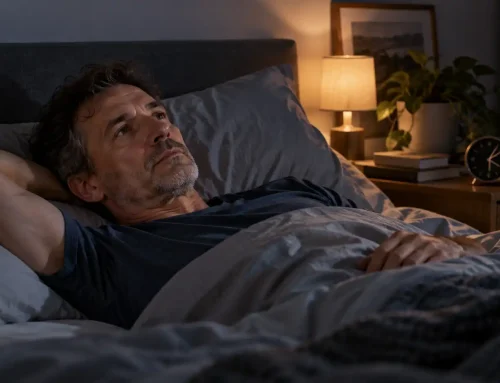
Someone may wait a long time for sleep but sleep well once asleep. Another falls asleep quickly but wakes repeatedly. A third sleeps many hours without feeling rested. A fourth struggles to stay awake during travel, conversation or work. These patterns do not necessarily need the same assessment.
Finding the right words is sometimes difficult. Saying you sleep badly does not identify difficulty falling asleep, waking, a shifted schedule or involuntary sleep as the main problem. Describing nights and days separately already provides useful information for consultation. MSKTC identifies insomnia, daytime sleepiness and disturbed sleep–wake rhythms among problems observed after traumatic brain injury.
These changes can follow injuries of different severities. They do not alone prove damage to a particular brain structure. The intensity experienced and everyday disruption should be taken seriously without assuming a single cause.
Why do nights and days become disrupted together?
The brain helps regulate waking and sleep. Regulatory mechanisms may be disrupted after injury. Other factors can also contribute: pain, stress, hospitalisation, irregular schedules, reduced activity, medication or breathing difficulties during sleep. Attributing everything to the injury may miss a treatable problem.
Imagine someone sleeping little at night, then lying down for two hours every afternoon to compensate. This seems logical but may reduce sleepiness in the evening. Conversely, someone refusing every break despite severe fatigue may end the day exhausted and tense. The aim is neither to ban naps nor prescribe one routine for all, but to understand how each habit affects the following day.
Insufficient sleep can amplify existing concentration difficulties, irritability and susceptibility to fatigue after injury. This does not mean poor sleep necessarily causes those symptoms. Several mechanisms may coexist.
Which signs suggest another cause needs investigation?
Loud snoring with observed breathing pauses, night-time choking sensations or marked daytime sleepiness may suggest sleep-related breathing disorders. Repeated leg movements, pain that wakes you, nightmares or substantial anxiety also deserve reporting. Symptoms guide assessment: a sleep study is neither automatic nor inherently pointless.
Review prescribed and over-the-counter medicines with the doctor too. Some increase drowsiness; others disturb falling asleep. Do not reduce or stop treatment yourself to test its role. Alcohol and some products used to induce sleep can also worsen sleep quality.
How can you prepare for an appointment without turning life into a laboratory?
A diary over one to two weeks may reveal patterns. Note approximate bedtimes and rising times, waking, naps, how rested you feel on waking and periods of uncontrollable sleepiness. Add only two or three relevant contextual factors: pain, recent medication, a particular activity or noise exposure.
For example: “Monday: up at 7 am, woke twice overnight, nap at 5 pm, difficulty falling asleep; Tuesday: no nap, intense fatigue at 3 pm.” This cannot diagnose a sleep disorder, but turns a general impression into observations the doctor can explore. France’s Assurance Maladie recommends this type of record when assessing sleep problems.
Ask not only whether you slept enough hours, but whether you stayed awake when needed and carried out activities safely. Daily impact matters as much as sleep duration.
Which changes could you try without aiming for a perfect night?
Some reasonable approaches can be discussed: keeping a relatively stable rising time, getting natural light in the morning, planning suitable daytime activities and gradually reducing evening stimulation. A reasonably quiet bedroom helps. These general suggestions must fit recovery, mobility and any specific medical recommendations.
Do not try twenty new rules tomorrow. One observable change is often more useful: for example, replacing a long, late nap with a shorter rest early in the afternoon, if suitable for your condition and agreed with your doctor. Then observe whether bedtime becomes easier, without expecting an immediate result or blaming yourself on difficult days.
Sleeping medicines, sedating antihistamines and supplements are not remedies to improvise after a brain injury. Their benefits and risks need assessment in light of alertness, memory, fall risk and other prescriptions.
When should you seek help?
Arrange an appointment if sleep remains disrupted, fatigue worsens, you fall asleep unintentionally or others notice breathing pauses. Specifically report risks while driving, on stairs or using machinery: avoid these activities when drowsy.
A doctor can investigate associated causes, review medication, offer follow-up and refer to a sleep service when needed. Improvement may require several adjustments; no result after two evenings does not prove a measure is useless.
Frequently asked questions
Key takeaways
Sleep problems after brain injury extend beyond insomnia. Falling asleep, waking, shifted rhythms and daytime sleepiness are different issues. Describing the full twenty-four-hour pattern and investigating associated causes helps obtain more suitable care. Difficulty waking someone after a recent head injury, however, is a medical emergency.
Sources
MSKTC — Sleep Problems After Traumatic Brain Injury
MSKTC — Fatigue After Traumatic Brain Injury
Assurance Maladie, « Insomnie de l'adulte : consultation et bilan médical ». — https://www.ameli.fr/assure/sante/themes/insomnie-adulte/diagnostic-evolution
Assurance Maladie, « Comment mieux dormir à l'âge adulte ? » (11 March 2026). — https://www.ameli.fr/assure/sante/themes/insomnie-adulte/vivre-insomnie
Assurance Maladie, « Diagnostic et traitement en cas de somnolence diurne excessive ». — https://www.ameli.fr/assure/sante/themes/somnolence-diurne/consultation-diagnostic-traitement
Centers for Disease Control and Prevention, « Symptoms of Mild TBI and Concussion ». — https://www.cdc.gov/traumatic-brain-injury/signs-symptoms/index.html
Last editorial review: October 2026
Partagez cet article, choisissez votre plateforme !
 Numa Costa
The pen name under which I write my articles and develop my editorial websites. Curious by nature, I enjoy understanding how things work, exploring everyday questions and making information easier to understand and use.
→ Learn more about the author