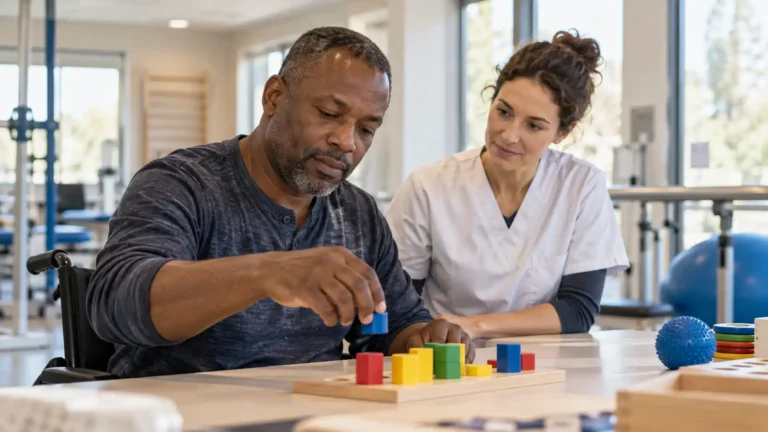
Caring for someone with a brain injury

Caring for someone with brain injury may involve organising appointments, handling unexpected events, supporting memory or movement and adapting a pre-existing relationship. The role is not doing everything for someone: identify what needs making safe, what they want to decide and which support preserves real independence.
Circumstances differ with injury severity, persistent difficulties, relationships and available resources. No family member or friend should improvise a care plan alone or make medical decisions belonging to professionals.
Important
This article provides general information. It cannot diagnose a brain injury or assess the seriousness of an individual situation remotely, and it does not replace an examination or advice from a qualified healthcare professional.
What does a carer actually do during the week?
Some difficulties after traumatic brain injury are obvious: help walking, marked fatigue or frequent care. Others are less visible: forgotten appointments, conversation difficulties, slowness, irritability or less reliable judgement in complex situations. Help should account for both.
A carer’s week may therefore include preparing consultation questions, supporting administrative tasks, checking treatment understanding according to professional instructions, arranging transport or simply allowing time to finish an action.
For example, someone can choose groceries and compare prices but loses track when several changes are imposed at the last moment. Preparing a list together and suggesting a quieter shopping time may help without automatically deciding for them.
Needs change. Considerable help just after homecoming may later be replaced by a tool or learning. Conversely, a long-hidden difficulty may appear when work or a more demanding activity resumes.
Helping without confusing independence, speed and safety
Independence is not doing everything alone, immediately and exactly as before. Distinguish choosing, carrying out actions and needing safety checks. Someone may choose their schedule but need reminders, or decide a meal while using a preparation sheet.
Before taking over, ask whether the person wants help organising steps, checking something together or trying and calling if needed. This leaves room for decisions and is more practical than taking over because it is quicker.
Risky tasks need discussion with the rehabilitation team. Attention or judgement difficulties have particular consequences for driving, dangerous tools or medication. A family member cannot independently determine medical fitness for these activities.
How can you prepare for consultation without speaking for the person?
The person may report different difficulties from those close. Context, memory, fatigue or different perceptions may explain this. The aim is not choosing between opposing accounts, but providing useful, respectful observations.
A brief record can include date, a specific situation, events, feelings and what helped. For example, two aisle changes during Tuesday shopping caused confusion, and an ordered list helped resume. This is more useful than generally declaring someone incapable of anything.
Where possible, the person chooses what to say and starts the consultation. With consent, someone close complements rather than monopolises their account. Legal protection or representation involves a separate framework and cannot simply be inferred from traumatic brain injury.
Sharing tasks: an arrangement that fits one page
The main risk is not only insufficient goodwill, but every decision falling on one person. MSKTC describes effects on family roles, available time, finances and communication.
A coordination sheet can distinguish care and appointments, home life, administration and transport, and relationships and leisure. For each, note who currently handles it, who can provide relief and when arrangements need review.
Make precise requests, such as accompanying Thursday’s appointment or preparing two meals this week. Clearly defined tasks often work better than a general invitation to say if anything is needed.
The aim is not turning home into a hospital ward. Time without medical or administrative discussion preserves family relationships.
Which support options exist in France?
Resources depend on age, independence, needs and administrative circumstances. The usual treating doctor, rehabilitation teams, hospital social services or support services can help identify appropriate options.
For disability-related needs in France, the departmental disability office, MDPH, may provide an entry point for some entitlements or referrals under applicable criteria. Mon Parcours Handicap describes respite and support options: day services, temporary accommodation, home relief or other arrangements. Access and funding are never automatic.
France’s carer’s leave, congé de proche aidant, may apply to some employees meeting legal conditions. It must not be confused with unconditional leave or automatic payment: procedures and possible entitlements should be checked with the relevant organisations.
Preserving relationships beyond responsibilities
Support is sometimes easier to accept when negotiable. Allow discussions of difficulties and other times when the person is not defined by lasting effects: music, suitable walks, meals, games or simply being together.
When tensions arise, state a specific problem rather than catalogue every change. Overlapping instructions at dinner suggests trying one step at a time; accusing someone of never paying attention may confuse a symptom with intention.
Persistent relationship difficulties may warrant family or psychological support. The carer’s health and needs are legitimate and do not become secondary because someone close was injured.
Frequently asked questions
Key takeaways
Being a carer does not mean becoming the only solution. Observing specific needs, supporting possible decisions, sharing responsibilities and knowing relief options makes help more sustainable. Medical and safety questions belong in professional discussion; the supported person’s life choices retain their place.
Sources
MSKTC — Impact of Traumatic Brain Injury on Families
MSKTC — Caregiver Stress After Traumatic Brain Injury
MSKTC — How a Traumatic Brain Injury Impacts Daily Life
Model Systems Knowledge Translation Center, « Cognitive Impairment Following Traumatic Brain Injury ». — https://msktc.org/tbi/factsheets/cognitive-problems-after-traumatic-brain-injury
Mon Parcours Handicap, « Les solutions de répit pour les aidants », updated November 2025. — https://www.monparcourshandicap.gouv.fr/aidant/les-solutions-de-repit-pour-les-aidants
Service-Public, « Congé de proche aidant », verified on 15 June 2026. — https://www.service-public.fr/particuliers/vosdroits/F16920
Last editorial review: October 2026
Partagez cet article, choisissez votre plateforme !
 Numa Costa
The pen name under which I write my articles and develop my editorial websites. Curious by nature, I enjoy understanding how things work, exploring everyday questions and making information easier to understand and use.
→ Learn more about the author