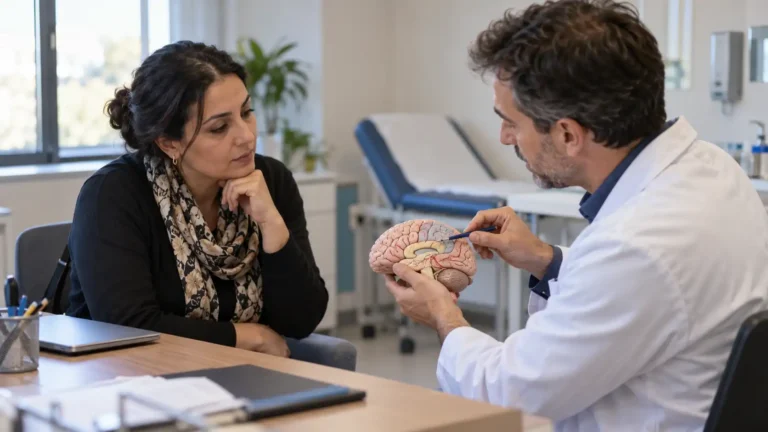
Returning home after a hospital stay

Returning home after hospitalisation for traumatic brain injury means more than walking through your door. Care must continue, the home must be usable, essential activities must remain possible and everyone must know whom to call if difficulties arise. Someone may be medically ready for discharge without regaining all previous abilities. Preparation must therefore reflect actual needs, not just a discharge date.
Important: sudden neurological deterioration, difficulty waking the person, a seizure, new weakness or sudden speech problems requires emergency medical help: call emergency services immediately. Home organisation advice never replaces emergency care.
Emergency numbers
United States: 911
United Kingdom: 999 or 112
European Union: 112
Elsewhere: your local emergency number
Important
This article provides general information. It cannot diagnose a brain injury or assess the seriousness of an individual situation remotely, and it does not replace an examination or advice from a qualified healthcare professional.
Before discharge: which information must be clear?
Asking whether everything is ready becomes more useful when broken down. The patient and, with consent, those close should know which treatments continue, which appointments are booked, which symptoms need reassessment and who will coordinate follow-up. In France, the discharge liaison letter specifically conveys necessary information to community healthcare professionals: the hospital stay summary, medication, arrangements needed and any monitoring.
Receiving a document does not mean understanding it. After brain injury, fatigue or memory problems may make a long explanation difficult to retain. Asking for stages, recording decisions and requesting clarification of important points makes the transition safer; it does not indicate inattention.
For example, knowing about three different tablets and two consultations does not establish which tablet is taken in the morning, when to renew it or whom to contact for a missing prescription. A chart showing the prescriber’s agreed times, professional contacts and appointments may reduce errors. No medicine should be stopped or changed solely on this article’s basis.
How can you check the home fits current abilities?
Home is familiar but may become demanding after hospitalisation. Reaching the toilet at night, negotiating a step, preparing food or answering a call while finding medication may combine balance, attention and planning. Identify specific difficult tasks rather than declare the whole home adapted.
A visit or discussion with an occupational therapist may identify obstacles: corridor lighting, essential objects within reach, slippery rugs, stairs, noise, storage or shower access. Adaptations are individual; automatically installing expensive equipment is neither essential nor always appropriate.
Start by observing three times of day: getting up, the main meal and bedtime. Which steps are independent? Which need someone present, written cues or physical assistance? Where safety matters, the task must not become an improvised test without professional advice.
A simple plan is better than a completely full day
In hospital, many decisions are organised: meals arrive, professionals give times and appointments are known. At home, shopping, post, medication and unexpected events need simultaneous consideration. Organisational difficulties may become apparent that were less visible in a facility.
Initially, a flexible framework may suffice: care time, a priority activity, rest and room for the unexpected. Cognitive fatigue does not always show on the face. Filling a day because someone is finally home may compromise what really matters.
If visiting the pharmacy already demands substantial attention, adding a supermarket trip and family visit that afternoon may be unreasonable. Distribution discussed with the follow-up team allows gradual trials of stamina without making each day an ordeal.
Who does what among professionals and family?
After discharge, the usual treating doctor and planned specialists can provide medical follow-up. Nursing, physiotherapy, speech and language therapy, occupational therapy or other interventions may be arranged according to need. Hospital or Assurance Maladie social services can clarify procedures and available support in France. Prado exists in some facilities and for some patient groups: availability is not automatic for everyone with brain injury.
For lasting difficulties, an application to France’s departmental disability office, the MDPH, may be considered according to the situation. French SAMSAH health and social support services for adults with disabilities may contribute after appropriate referral in some pathways; they replace neither emergency care nor medical follow-up.
Within families, discuss responsibilities explicitly. Taking care of everything may initially be generous but become unsustainable. Who accompanies appointments or prepares documents? What does the person want to control? Help should support abilities rather than remove decision-making.
The first week: a small, useful record
The priority is not measuring performance daily. Record only what will actually guide the next appointment:
• Activities: what was done, with which help and in what surroundings.
• Tolerance: fatigue, pain, dizziness, irritability or rest needed afterwards.
• Follow-up: completed appointments, prescriptions needing clarification and questions.
• Safety: falls, situations avoided or new symptoms to report promptly.
A precise statement helps more than saying things are not going well: fifteen minutes cooking followed by needing to lie down for an hour gives healthcare staff a starting point. Specific discharge instructions and monitoring always take priority over this general model.
If home proves harder than expected
Discharge is not an examination to pass once and for all. Insufficient help, unsuitable housing or unmanageable appointments justifies prompt contact with the follow-up team to review arrangements. This may mean adjusting care, exploring home assistance or discussing another support option. Families should not fill every service gap alone.
Relief can also be arranged for those close: everyone needs sleep, work and time free from supervision responsibilities where compatible with the person’s safety.
Four questions before leaving hospital
1. Which signs mean we should contact a doctor or emergency department without delay?
2. Who coordinates follow-up, and which appointments are booked?
3. Which tasks still need help or home adaptations?
4. What should we do if reality differs from the plan?
These turn the abstract idea of arranging discharge into verifiable decisions. A successful homecoming is adaptable and sufficiently safe, not proof that every lasting effect has disappeared.
Frequently asked questions
Key takeaways
These turn the abstract idea of arranging discharge into verifiable decisions. A successful homecoming is adaptable and sufficiently safe, not proof that every lasting effect has disappeared.
Sources
MSKTC — Acute Inpatient Rehabilitation for TBI
MSKTC — How a Traumatic Brain Injury Impacts Daily Life
Model Systems Knowledge Translation Center (MSKTC), « Transitioning Home After Rehabilitation » (updated 2026). — https://msktc.org/tbi/factsheets/transitioning-home-after-rehabilitation
MSKTC, « Understanding TBI, Part 4: The Impact of a Recent TBI on Family Members and What They Can Do to Help ». — https://msktc.org/tbi/factsheets/understanding-tbi-part-4-impact-recent-tbi-family-members-and-what-they-can-do-help
Assurance Maladie, « Lettre de liaison de sortie : personnaliser et coordonner les soins après l’hospitalisation ». — https://www.ameli.fr/etablissement/exercice-professionnel/lettre-liaison-sortie-soins-apres-hopitalisation
Assurance Maladie, « Hospitalisation : les types de séjour et les démarches à effectuer » (2026). — https://www.ameli.fr/assure/droits-demarches/maladie-accident-hospitalisation/hospitalisation
Assurance Maladie, « Le service social de l’Assurance Maladie, votre accompagnement social en santé » (2026). — https://www.ameli.fr/assure/droits-demarches/difficultes-acces-droits-soins/service-social
Mon Parcours Handicap, « Qu’est-ce qu’un service d’accompagnement médico-social pour adultes handicapés (SAMSAH) ? ». — https://www.monparcourshandicap.gouv.fr/logement/quest-ce-quun-service-daccompagnement-medico-social-pour-adultes-handicapes
Centers for Disease Control and Prevention (CDC), « Symptoms of Mild TBI and Concussion ». — https://www.cdc.gov/traumatic-brain-injury/signs-symptoms/index.html
Last editorial review: October 2026
Partagez cet article, choisissez votre plateforme !
 Numa Costa
The pen name under which I write my articles and develop my editorial websites. Curious by nature, I enjoy understanding how things work, exploring everyday questions and making information easier to understand and use.
→ Learn more about the author